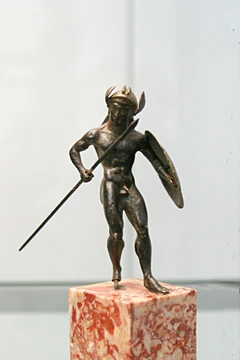
Battle of Cannae
Hannibal encircled and destroyed a larger Roman army at Cannae.

The Carthaginians and their allies, led by Hannibal, surrounded and practically annihilated a larger Roman and Italian army under the consuls Lucius Aemilius Paullus and Gaius Terentius Varro. It is regarded as one of the greatest tactical feats in military history and one of the worst defeats in Roman history, and it cemented Hannibal's reputation as one of antiquity's greatest tacticians.
- location
- Cannae, Apulia, southeast Italy
- combatants
- Roman Republic vs. Carthage
- roman_commanders
- Lucius Aemilius Paullus, Gaius Terentius Varro
- carthaginian_commander
- Hannibal
- result
- Carthaginian victory; Roman army annihilated
Lore & Background
He quickly won major victories over the Romans at Trebia and at Lake Trasimene. After these losses, the Romans appointed Quintus Fabius Maximus Verrucosus as dictator to deal with the threat. Fabius used attrition warfare against Hannibal, cutting off his supply lines and avoiding pitched battles. These tactics proved unpopular with the Romans who, as they recovered from the shock of Hannibal's victories, began to question the wisdom of the Fabian strategy, which had given the Carthaginian army a chance to regroup.
Reader's Guide
The Battle of Cannae is significant as a classic example of a battle of annihilation, where Hannibal used the double envelopment tactic to surround and destroy a numerically superior Roman force. Following the defeat, Capua and several other Italian city-states defected from the Roman Republic to Carthage. Despite the extreme loss of men and equipment, and a second massive defeat later that same year at Silva Litana, the Romans refused to surrender to Hannibal. His offer to ransom survivors was brusquely refused. The Romans fought for 14 more years until they achieved victory at the Battle of Zama.
Did You Know?
- The Romans massed their heavy infantry in a deeper formation than usual at Cannae.
- Hannibal used the double envelopment tactic to surround and trap the majority of the Roman army.
- After the defeat, the Romans buried four people alive as a sacrifice to their gods.
The Double Envelopment
As the Roman center advanced, Hannibal's flanking elements folded inward, sealing the bulk of the Roman army inside an encirclement from which escape became impossible. The trapped soldiers were then systematically slaughtered. The engagement stands as one of the most lethal single days of combat in recorded history.
The Unprecedented Commitment
The dictator Quintus Fabius Maximus Verrucosus had adopted a strategy of attrition, severing Hannibal's supply lines and refusing to engage in pitched battle. Though effective, this approach proved deeply unpopular among the Roman populace, who feared that continued Carthaginian plundering would drive Italian allies to defect. When Fabius's term expired, the Senate declined to renew his extraordinary powers.
Panic and Defiance in Rome
When word of the catastrophic defeat reached the capital, the city of Rome was seized by a terror unlike anything it had known. The authorities turned to extraordinary and, by later standards, almost surreal measures to appease their gods: they consulted the sacred Sibylline Books, dispatched a delegation under Quintus Fabius Pictor all the way to the Delphic oracle in Greece, and performed the grim ritual of burying four living people as human sacrifice. The military situation demanded equally drastic responses. To raise two fresh legions, the state lowered the minimum draft age and pressed into service criminals, debtors, and even slaves. The crisis deepened when a second major defeat followed at Silva Litana later that same year, and when Capua and several other Italian city-states formally defected to Carthage. Yet despite the staggering loss of men, equipment, and allies, the Roman leadership flatly rejected Hannibal's offer to ransom surviving prisoners. The Republic chose to fight on, and it would be fourteen more years before the war finally concluded with Roman victory at the Battle of Zama.
Legacy and the Scapegoat Narrative
Strategists and historians across the ages have cited it as the definitive example of a battle of annihilation, a case study in how a smaller, more flexible force can encircle and destroy a numerically superior opponent. It cemented Hannibal's enduring reputation as one of the greatest tactical minds of the ancient world. Yet the narrative surrounding the Roman side has been shaped by political and social biases. The traditional account places much of the blame on consul Gaius Terentius Varro, portraying him as a reckless man of humble origins. Modern scholars suggest his low social standing was exaggerated by the sources, and that he was effectively made a scapegoat by the aristocratic establishment. His fellow consul, Lucius Aemilius Paullus, had powerful descendants willing to defend his memory—most notably his grandson Scipio Aemilianus, the patron of Polybius, one of the principal sources for this history. The daily alternation of command required by Roman law meant both consuls shared responsibility, yet history remembered only one.
Frequently Asked Questions
Who fought in the Battle of Cannae?
The Roman Republic clashed with Carthage and its allied forces in this engagement. The Roman side was led by consuls Lucius Aemilius Paullus and Gaius Terentius Varro, while Hannibal commanded the Carthaginian army.
What happened at the Battle of Cannae?
Hannibal executed a double envelopment that trapped and destroyed an outnumbering Roman force in a single day. The Roman army was essentially annihilated, making it one of the most lopsided defeats in the republic's history.
Where did the Battle of Cannae take place?
The fighting occurred at Cannae, a town in the region of Apulia in southeast Italy. The site gave the battle its name and remains a well-known location in modern Puglia.
Why is the Battle of Cannae so famous in military history?
It is widely regarded as one of the greatest tactical achievements ever recorded, showcasing a textbook double-envelopment maneuver. The battle also cemented Hannibal's legacy as one of the most brilliant tacticians of the ancient world.
How did the Battle of Cannae end for the Romans?
The Roman army was surrounded and destroyed, with losses so severe that the defeat is remembered as one of the worst in Roman military history. The annihilation of that field army left the Republic in a critical strategic crisis.
More in Military History & Battles 1-20
Spotted an error? Know more?
This is a living reference — every entry is fact-audited, and reader corrections feed straight into our audit queue. Suggest an edit · See this site's audit record