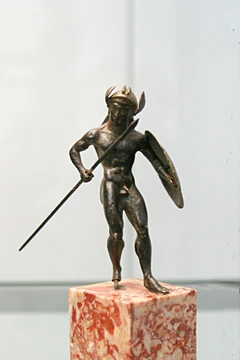
Battle of Marathon
Greek victory over Persia at Marathon ended the first invasion.

It marked the culmination of King Darius I's first attempt to subjugate Greece, resulting in a crushing Greek defeat of the more numerous Persians and a turning point in the Greco-Persian Wars.
- location
- Marathon, Attica
- combatants
- Athens and Plataea vs. Persian Empire
- commanders
- Miltiades (Athenian); Datis and Artaphernes (Persian)
- outcome
- Greek victory
- significance
- Ended first Persian invasion of Greece; showed Persians could be beaten
Lore & Background
The battle's roots lay in the Ionian Revolt, when Athens and Eretria sent forces to support Ionian cities against Persian rule. They captured and burned Sardis but retreated with heavy losses. In response, Darius swore vengeance, reportedly shooting an arrow toward heaven and saying, 'Zeus, that it may be granted me to take vengeance upon the Athenians!' He also ordered a servant to remind him 'Master, remember the Athenians' three times before dinner each day. The Persians captured Eretria, then landed at Marathon. The Athenians, joined by a small Plataean force, marched to Marathon and blocked the plain's exits. They sent a message to Sparta, but the Spartans were involved in a religious festival and did not come.
Reader's Guide
The Battle of Marathon was a watershed in the Greco-Persian Wars, demonstrating that the Persians could be defeated. The Greek triumph, overwhelmingly won by the Athenians, raised Greek esteem of Athens and showed that victories were possible without Sparta, then seen as the major military force. The battle's location—with marshes and mountainous terrain—prevented the Persian cavalry from engaging, allowing Miltiades to order a general attack. He reinforced his flanks, luring Persian fighters into the center, then enveloped and routed them. The Persian army fled in panic toward their ships, suffering heavy losses. The victory at Marathon is often seen as a pivotal moment in Mediterranean and European history, contributing to the rise of Classical Greek civilization, which has been enduringly influential in Western society.
Did You Know?
- The Athenians and Plataeans blocked the two exits from the plain of Marathon, preventing the Persian cavalry from joining the infantry.
- Darius reportedly shot an arrow toward heaven and swore vengeance on the Athenians after the burning of Sardis.
- The Spartans did not participate in the battle because they were involved in a religious festival.
- The Persian force retreated to Asia after the defeat, ending the first Persian invasion of Greece.
The Oath of Vengeance
The first Persian invasion of Greece was born from a specific act of defiance. During the Ionian Revolt, the island cities of Ionia attempted to overthrow Persian rule, and only two mainland Greek states—Athens and Eretria—sent military aid to their cause. The joint force achieved a dramatic success by capturing and setting fire to Sardis, but the victory proved pyrrhic as they were forced to withdraw with severe casualties. The humiliation struck deep at the Persian throne. According to the historian Herodotus, King Darius I summoned his bow, loosed an arrow skyward, and declared his desire for Zeus to grant him vengeance against the Athenians. He also commanded a servant to remind him of the Athenians three times before every meal. Darius, who had consolidated power as a usurper and had already extended Persian dominion over Thrace and Macedon, viewed the Greek mainland as a persistent threat to imperial stability. The Ionian uprising had exposed a vulnerability, and the involvement of Athens and Eretria transformed a regional rebellion into a personal grudge that would drive an entire invasion across the Aegean.
The Geometry of Victory
The tactical decisions at Marathon reveal a Greek command that understood the terrain as well as the enemy. The Athenian general Miltiades selected a battlefield bounded by marshland and hills, a choice that effectively neutralized the Persian cavalry and forced the enemy to fight on foot. The Persian army, led by Datis and Artaphernes, was composed largely of missile troops—archers and light infantry—rather than heavy shock warriors. Miltiades exploited this by ordering a direct frontal assault while simultaneously thickening his flanks. The center, deliberately weakened, drew the Persians' strongest fighters inward, creating a vulnerable core. Once the enemy committed, the reinforced Greek wings wheeled inward in a pincer that enveloped the Persian lines. The result was catastrophic: the Persian formation shattered, and soldiers broke and ran toward their ships in the bay, where they were cut down in large numbers. The Athenians, joined by a small contingent from Plataea, had also blocked both exits from the Marathon plain, ensuring no organized retreat was possible. The crushing defeat ended the first Persian invasion and sent the surviving force back across the sea to Asia.
Athens Without Sparta
Yet when the Persian fleet landed near Marathon, the Spartans were absent. The Athenians had dispatched a messenger to request reinforcements, but upon arrival the Spartan authorities cited an ongoing religious festival as their reason for non-intervention. The consequence was profound: the battle was fought and won almost entirely by Athenian citizens, with only a modest Plataean contingent alongside them. This outcome shattered the prevailing assumption that Greek military supremacy belonged to Sparta. The victory at Marathon demonstrated that Athens could stand alone against a far larger and better-equipped enemy, and it elevated Athenian prestige across the Greek world in a way that no previous engagement had achieved. The Persians, who had already besieged and taken Eretria and subjugated the Cyclades islands before reaching Attica, found their punitive campaign ended not by the legendary Spartan phalanx but by the citizens of a single city-state.
The Watershed
The defeat at Marathon did more than end a single military campaign; it fundamentally altered the psychological landscape of the Greco-Persian conflict. For the first time, Greek forces had proven that the Persian war machine was not invincible, and the eventual Greek triumph across the wars can be traced back to the confidence born on that plain. The following two centuries saw the flowering of Classical Greek civilization—a cultural and intellectual achievement that has exerted enduring influence on Western society—and Marathon is frequently cited as the pivotal moment that made that trajectory possible. The Persian side, meanwhile, was far from finished. Today, Marathon remains one of the most celebrated episodes in Mediterranean and European history, a symbol of a small community standing against overwhelming imperial power and prevailing.
Frequently Asked Questions
What was the Battle of Marathon?
It was a 490 BC land battle on the plains of Marathon in Attica, where a smaller Greek army repelled a larger Persian invasion force. The engagement brought King Darius I's first campaign to conquer Greece to a close.
Who fought in the Battle of Marathon?
The Greek side was made up of Athenian hoplites reinforced by a Plataean contingent, while the opposing army was a Persian expeditionary force that outnumbered the Greeks. The two sides clashed in open-field combat on the Marathon plain.
Who commanded the Greek forces at Marathon?
The Athenian general Miltiades led the Greek army and shaped the tactical approach that produced the victory. The Persian expedition was directed by the commanders Datis and Artaphernes.
Why is the Battle of Marathon considered important?
It demonstrated that a numerically superior Persian force could be decisively beaten in open battle, breaking the myth of Persian invincibility. The result ended the first Persian invasion of mainland Greece and proved a pivotal moment in the broader Greco-Persian conflict.
What was the outcome of the Battle of Marathon?
The Greeks won a clear-cut victory, routing the Persian army and inflicting severe losses that forced its retreat. This success effectively closed out Darius I's initial attempt to bring Greece under Persian control.
More in Military History & Battles 1-20
Spotted an error? Know more?
This is a living reference — every entry is fact-audited, and reader corrections feed straight into our audit queue. Suggest an edit · See this site's audit record