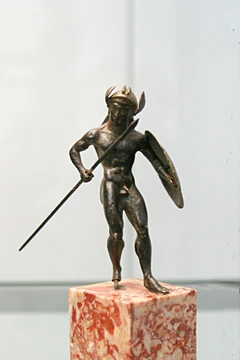
Battle of Gaugamela
Decisive 331 BC battle that crippled the Achaemenid Empire.

The Battle of Gaugamela (GAW-gə-MEE-lə), also called the Battle of Arbela, took place in 331 BC between the forces of the Army of Macedon under Alexander the Great and the Persian Army under King Darius III. It was the second and final battle between the two kings, and is considered to be the final blow to the Achaemenid Empire, though its complete conquest would not be achieved until after Darius's death and further campaigns. The fighting took place in Gaugamela, a village on the banks of the river Bumodus, north of Arbela (modern-day Erbil, in Iraqi Kurdistan). Despite being heavily outnumbered, the Army of Macedon emerged victorious due to the employment of superior tactics and the clever usage of light infantry forces. It was a decisive victory for the League of Corinth, and it led to the fall of the Achaemenid Empire and of Darius III.
- date
- 331 BC
- location
- Gaugamela, on the banks of the river Bumodus, north of Arbela (modern-day Erbil, Iraqi Kurdistan)
- combatants
- Army of Macedon (Alexander the Great) vs. Persian Army (Darius III)
- outcome
- Decisive Macedonian victory
- significance
- Final blow to the Achaemenid Empire, though its complete conquest was not completed until after Darius's death and further campaigns
Lore & Background
Alexander's victory at Issus gave him control of southern Asia Minor. Darius retreated to Babylon to regroup. Darius attempted three rounds of negotiations, offering ransom, territory, and even co-rulership, but Alexander refused all offers, insisting there could be only one king of Asia. In late spring or early summer of 331 BC, Alexander marched from Egypt through Syria toward the Tigris river. He crossed the Euphrates near Thapsacus and followed a northern route to Mesopotamia. After crossing the Tigris with difficulty, a near-total lunar eclipse occurred on 20–21 September 331 BC. Alexander allowed his troops four days of rest before his army located Darius' forces at Gaugamela, about eight miles away. The battle date is calculated as 1 October 331 BC. Several researchers have criticized the Persians for failing to harass Alexander's supply lines. Classical scholar Peter Green thinks Alexander's northern route caught the Persians off guard. Historian Jona Lendering argues Darius intentionally led the Macedonians to Gaugamela. The precise location of the battlefield is not known with certainty, as ancient sources are inconsistent.
Reader's Guide
The Battle of Gaugamela marked the decisive end of the Achaemenid Empire, the largest empire the world had yet seen. Alexander's victory, achieved despite being heavily outnumbered, demonstrated his tactical brilliance and the effectiveness of his light infantry. The battle's outcome led directly to the complete conquest of Persia by Alexander, fundamentally altering the political and cultural landscape of the ancient Near East. The fall of Darius III and his empire paved the way for the Hellenistic period, spreading Greek culture and influence across a vast territory. The battle is also notable for the extensive but ultimately failed diplomatic efforts by Darius to avoid a final confrontation, including offers of territory, ransom, and even co-rulership. The uncertainty over the exact battlefield location reflects the challenges of reconstructing ancient history from sometimes inconsistent sources.
Did You Know?
- The battle is also called the Battle of Arbela.
- Darius III offered Alexander all territory west of the Euphrates, co-rulership, and 30,000 talents of silver in a final negotiation attempt.
- A near-total lunar eclipse occurred on 20–21 September 331 BC, after which Alexander rested his troops for four days before locating Darius' army.
- The precise location of the battlefield is not known with certainty due to inconsistent ancient sources.
The Decisive Engagement
The Battle of Gaugamela, fought in 331 BC, stands as the culminating confrontation between Alexander the Great's Macedonian army and the Persian forces commanded by King Darius III. Taking place at a village on the banks of the Bumodus river, north of Arbela (present-day Erbil in Iraqi Kurdistan), this engagement marked the second and final direct clash between the two monarchs. Despite facing a vastly larger Persian host, Alexander's forces prevailed through superior tactical execution and the effective deployment of light infantry units. The victory proved decisive for the League of Corinth and delivered what is regarded as the final blow to the Achaemenid Empire, sealing its complete conquest. With Darius III's defeat, the ancient Persian state that had dominated the Near East for centuries was brought to an end, reshaping the political landscape of the ancient world.
Three Failed Peace Offers
Before the armies met on the plain near Arbela, Darius III made three separate diplomatic overtures to halt Alexander's advance, each rejected. After the fall of Tyre, a second proposal extended an offer of marriage to Darius' daughter Stateira II, along with all land west of the Halys and a friendship treaty. The third and most generous offer, made after Alexander left Egypt, included 30,000 talents of silver, all territory west of the Euphrates, co-rulership of the empire, and the hand of one of Darius' daughters. When his general Parmenion suggested accepting, Alexander famously replied that he would only do so if he were Parmenion, insisting that only one king could rule Asia.
The March to the Tigris
In the late spring and early summer of 331 BC, Alexander led his army northeast from Egypt through Syria toward the Tigris. By July or August he reached Thapsacus on the Euphrates, where Darius had stationed Mazaeus with 3,000 cavalry to guard the crossing. Mazaeus fled at the Macedonians' approach, leaving the river unopposed. Rather than pressing directly southeast toward Babylon, Alexander chose a northern route that kept the Euphrates and the Armenian mountains on his left flank. This detour offered practical advantages: easier foraging for provisions and avoidance of the punishing heat of the more direct path. Captured Persian scouts confirmed that Darius had already encamped beyond the Tigris. Alexander arrived at the Tigris in late September and, despite significant difficulty, succeeded in crossing the river to find it undefended, placing his army in position for the decisive confrontation that would follow.
The Collapse of an Empire
The defeat at Gaugamela represented the terminal crisis of the Achaemenid dynasty. The Macedonian victory at Gaugamela, achieved despite being heavily outnumbered, confirmed Alexander's dominance and brought the complete conquest of the Achaemenid Empire under the banner of the League of Corinth. With Darius' final military defeat, the political structure that had governed the Near East for generations dissolved, and the ancient world entered a new era of Hellenistic power.
Frequently Asked Questions
What was the Battle of Gaugamela?
It was a decisive 331 BC engagement in which Alexander the Great's Macedonian army clashed with King Darius III's Persian forces near the village of Gaugamela, along the Bumodus River. The fight is also commonly called the Battle of Arbela because of its proximity to that ancient city.
Where exactly did the Battle of Gaugamela take place?
The fighting unfolded on the banks of the Bumodus River, just north of the city of Arbela, in the region that is now Iraqi Kurdistan near modern-day Erbil.
Who were the main combatants at Gaugamela?
The Army of Macedon under Alexander the Great faced the Persian Army commanded by King Darius III. It was the second and final direct confrontation between these two rulers.
What was the outcome of the Battle of Gaugamela?
Alexander's forces delivered a crushing victory despite being heavily outnumbered, effectively breaking the backbone of the Achaemenid war machine. The empire's full collapse, however, required additional campaigns after Darius III's eventual death.
Why is the Battle of Gaugamela considered so important?
It is widely regarded as the final, decisive blow that crippled the Achaemenid Empire and set the stage for Macedonian dominance across the ancient Near East. Without this defeat, Darius III would not have been forced into a desperate flight that ended his reign.
More in Military History & Battles 1-20
Spotted an error? Know more?
This is a living reference — every entry is fact-audited, and reader corrections feed straight into our audit queue. Suggest an edit · See this site's audit record