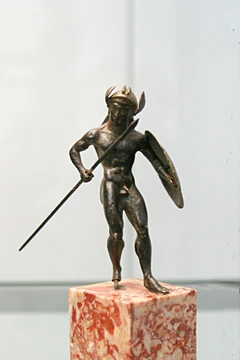
Battle of Issus
Alexander's first victory over Darius III, securing Asia Minor.

It was the second major battle in Alexander's invasion of the Persian empire and the first encounter between the two commanders. The battle resulted in a Macedonian victory, forcing Darius to flee and leaving his family and treasury to be captured by Alexander.
- location
- Southern Anatolia, near the city of Issus (present-day Iskenderun, Turkey)
- combatants
- Hellenic League (Alexander the Great) vs. Achaemenid Empire (Darius III)
- result
- Macedonian victory
Lore & Background
The battle took place south of the ancient city Issus, near the Pinarus River, where the narrow coastal plain (only 2.6 km wide) prevented Darius from using his numerical superiority. Alexander had earlier defeated Persian satraps at the Battle of the Granicus and occupied much of Asia Minor. Darius gathered reinforcements and marched behind Alexander's advance, cutting his supply lines, forcing Alexander to countermarch north to meet him. Darius formed his line with heavy cavalry on his right, Greek mercenaries in the center, and Persian infantry (Cardaces) extending into the foothills. Alexander led his Companion cavalry on the right flank, with Thessalian cavalry under Parmenion on the left. The Persian cavalry initially charged Parmenion's forces, while Alexander's center phalanx suffered heavily against the Greek mercenaries. Alexander then led the Hypaspists and Companions in a direct assault on Darius, causing the Persian king to flee. Alexander then turned to aid his left flank and center, breaking the Greek mercenaries and routing the Persian army.
Reader's Guide
The Battle of Issus was a pivotal engagement in Alexander's campaign against the Persian Empire. It marked the first direct confrontation between Alexander and Darius III, demonstrating Alexander's tactical brilliance in using terrain to neutralize a larger enemy force. The narrow battlefield at Issus prevented Darius from deploying his full army, a factor that modern historians consider crucial to the outcome. The battle also resulted in the capture of Darius's family and treasury, a psychological blow that weakened Persian morale. Alexander's victory at Issus opened the way for his subsequent conquest of Phoenicia and Egypt, and set the stage for the final decisive battle at Gaugamela. The location of the Pinarus River remains debated among historians, with some identifying it as the Payas River based on ancient accounts.
Did You Know?
- The battle occurred on a narrow coastal plain only 2.6 km wide, preventing Darius from using his numerical superiority.
- Darius cut off the hands of all sick and wounded soldiers Alexander had left behind at Issus before the battle.
- Alexander founded the city of Iskenderun (Turkish for 'Alexandria') near the battlefield to commemorate his victory.
The Flanking Gambit
After the Granicus victory, Alexander pushed through Asia Minor to deny the Persian fleet coastal bases, capturing Miletus and Halicarnassus. When news reached him at Tarsus that Darius was massing forces in Babylon, Alexander split his forces—keeping his main body at Tarsus while sending Parmenion to secure the coast near Issus. Darius, aware Parmenion held the Pass of Jonah, chose a northern route, captured Issus without resistance, and cut off the wounded left behind. He then advanced south until his scouts spotted Alexander marching north, forcing him to camp on the narrow coastal plain. The result was a dramatic reversal: Darius had executed a large flanking maneuver that placed his army behind Alexander's supply lines, compelling the Macedonian king to march toward him rather than the other way around. What appeared as a defensive posture by Darius was actually the product of Alexander being caught off guard.
A Stage Constrained by Geography
The battlefield at Issus was defined by terrain that severely constrained the larger force. The distance between the Gulf of Issus and the surrounding mountains was only 2.6 kilometers, creating a tight coastal corridor where Darius' numerical superiority could not be fully exploited. The engagement took place on either side of the small Pinarus River, south of the ancient city of Issus, near what is now the Turkish city of Iskenderun—a name Alexander himself chose as the Greek equivalent to commemorate his triumph. The identity of the Pinarus has sparked over eighty years of scholarly debate. Older historians identified it as the Deli Tchai river, but N.G.L. Hammond and A.M. Devine argued it was actually the Payas River, basing their conclusion on Callisthenes' battlefield measurements, the distances each army marched before the clash, and Diodorus' post-battle distance records. Devine's own field examination of the river's course, which he believed had not shifted dramatically since antiquity, further supported this identification.
The Scale of the Armies
Ancient sources present wildly divergent figures for the Persian force.
Who Was Truly on the Defensive?
A persistent question among historians concerns which side was truly on the defensive at Issus. One modern reading, rooted in Curtius' account, suggests Darius was compelled to shift his camp onto terrain that favored Alexander because the Macedonian king was holding a defensive position following advice from his war council and Parmenion. Darius faced compounding pressures: his vast army could not sustain itself in the field through winter, and unrest was already brewing in his Phoenician cities at the approach of Alexander. These factors forced him to compress his large force onto a small battlefield, a tactical disadvantage. Alexander, meanwhile, had been waiting near Myriandus, fifteen kilometers west of the Belen Pass, intending to spring a trap as Darius crossed through that narrow defile or the Pillar of Jonah, where the Persian army would be disorganized and disjointed. Darius instead moved north from Sochoi, around the mountains, and emerged behind Alexander's position. The resulting impression that Darius was defending was, in reality, the product of Alexander being forced to march to meet him.
Frequently Asked Questions
Who fought in the Battle of Issus?
The Hellenic League under Alexander the Great clashed with the Achaemenid Persian Empire led by Darius III. It was the first direct, face-to-face confrontation between these two rival commanders.
Where did the Battle of Issus take place?
The engagement occurred in southern Anatolia, near the coastal city of Issus, which corresponds to present-day Iskenderun in modern Turkey.
What was the outcome of the Battle of Issus?
Alexander's Macedonian forces won decisively, compelling Darius to abandon the field and flee. In the aftermath, Alexander captured Darius's family members and the Persian royal treasury.
Why is the Battle of Issus considered important?
It was the second major engagement of Alexander's campaign into Persia and effectively secured Macedonian control over Asia Minor. The victory also shattered the perception of Persian invincibility among the Hellenic world.
How did the Battle of Issus shape Alexander's broader campaign?
By defeating Darius III in their first head-to-head meeting, Alexander neutralized the immediate Persian threat in the western provinces. This cleared the path for his deeper advance into the heart of the Achaemenid Empire.
More in Military History & Battles 1-20
Spotted an error? Know more?
This is a living reference — every entry is fact-audited, and reader corrections feed straight into our audit queue. Suggest an edit · See this site's audit record