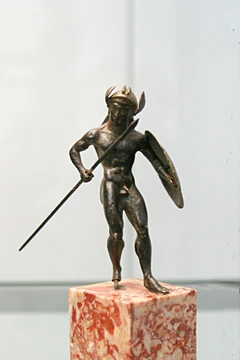
Battle of Plataea
Final land battle ending the second Persian invasion of Greece.

It pitted an Achaemenid army led by Mardonius, allied with Boeotia, Thessaly, and Macedon, against a Spartan-led Hellenic alliance that included Athens, Corinth, Tegea, Megara, and other city-states. The Greek victory decisively ended the invasion, destroying the Persian army and killing Mardonius.
- location
- Near Plataea, Boeotia
- combatants
- Achaemenid Empire vs. Hellenic alliance (Sparta, Athens, Corinth, Tegea, Megara, others)
- commanders
- Mardonius (Persian); Pausanias (Greek)
- outcome
- Decisive Greek victory; end of the second Persian invasion of Greece
Lore & Background
The Persians retreated to Boeotia and built a fortified camp near Plataea. The Greeks refused to engage on terrain favorable to Persian cavalry, leading to an eleven-day stalemate. When Greek supply lines were disrupted, they attempted a retreat, causing their battle line to fragment. Mardonius, believing the Greeks were in full retreat, ordered a pursuit. The Greeks—especially Spartans, Tegeans, and Athenians—halted and gave battle, routing the lightly armed Persian infantry and killing Mardonius. A large portion of the Persian army was trapped in its camp and killed. On the same day, the remnants of the Persian navy were allegedly destroyed at the Battle of Mycale.
Reader's Guide
The Battle of Plataea is significant as the decisive land engagement that ended the second Persian invasion of Greece, securing Greek independence from Achaemenid rule. The victory demonstrated the effectiveness of hoplite infantry against larger but lighter-armed Persian forces, especially when the Greeks held defensive positions and exploited Persian overconfidence. The battle also solidified Spartan military leadership within the Hellenic alliance, though Athens' role was crucial. The destruction of Mardonius' army, combined with the naval victory at Mycale, prevented further Persian attempts to conquer mainland Greece for decades. The battle's legacy includes its influence on later Greek military tactics and its role in shaping the classical Greek identity of resistance against Eastern empires.
Did You Know?
- The battle followed an eleven-day stalemate because the Greeks refused to fight on terrain favorable to Persian cavalry.
- Mardonius was killed during the battle, and a large portion of the Persian army was trapped in its camp and killed.
- The Persian army included troops from Bactria, India, and Sacae, as well as allied Greeks from Boeotia, Thessaly, and Macedon.
The Road to Plataea: Strategy and Political Pressure
He left the bulk of the army under the command of his general Mardonius, who chose to winter his troops in Thessaly rather than press an immediate assault. The following months brought a tense diplomatic standoff. Mardonius attempted to peel Athens away from the Greek alliance by sending peace overtures through Alexander I of Macedon, but the Athenians refused. When the Persians marched south again, Athens was evacuated for a second time, and Mardonius renewed his offer before the refugee population on Salamis. Faced with the prospect of losing their most vital ally, the Spartans—initially delayed by the Hyacinthus festival—ultimately mobilized. Five thousand Spartiates advanced up the Eurotas River toward Oresthasium, and the great allied army began its march north.
Eleven Days of Stalemate: Terrain and Attrition
The geography of that position gave the Persians a decisive tactical advantage: the open ground surrounding their encampment was ideal terrain for their cavalry, a force estimated at around ten thousand riders. The Greek alliance, dominated by heavy infantry hoplites from Sparta, Athens, Corinth, Tegea, and Megara, recognized this and refused to commit their battle line into the open fields where mounted Persian horsemen could sweep around their flanks. The result was an eleven-day stalemate in which neither side would yield ground. Tension mounted as the Greek supply lines were progressively disrupted, eroding the allied army's ability to sustain its position. The standoff eventually broke not through a planned maneuver but through a desperate attempt at withdrawal, which shattered the cohesion of the Greek formation and set the stage for the climactic engagement.
The Turning Point: Mardonius' Death and the Rout
The battle's decisive moment arrived through a misread of the battlefield. As the Greek line fragmented during a disrupted retreat, Mardonius interpreted the disorder as a full collapse and committed his forces to a pursuit. The gamble proved fatal. The Spartan, Tegean, and Athenian contingents—rather than fleeing—halted, reformed, and turned to meet the advancing Persians in close combat. The lightly armed Persian infantry, outmatched by the heavy Greek hoplite formations, were routed in the ensuing melee. Mardonius himself was killed in the fighting, a blow that shattered the command structure of the Achaemenid army. With their general dead and their field forces broken, a large portion of the Persian host found itself trapped inside the fortified camp at Plataea, where it was slaughtered. The destruction of this army represented the annihilation of the second great Persian invasion force and, combined with the simultaneous naval defeat at Mycale, effectively ended any realistic prospect of further Achaemenid expansion into the Greek world.
The Alliance That Held: Command, Numbers, and Unity
The victory at Plataea was made possible by a coalition forged under extraordinary pressure. The confederate alliance of Greek city-states, originally convened at Corinth in 481 BC, brought together Athens, Corinth, Tegea, Megara, and numerous other polities under a common war effort. Sparta contributed what may have been the largest force it had ever projected beyond the Isthmus of Corinth: forty-five thousand men, including five thousand full-citizen Spartiates, five thousand perioeci hoplites, and thirty-five thousand helot attendants. Pausanias, serving as regent for his cousin Pleistarchus, was appointed to command the Spartan contingent, with Euryanax as his deputy. On the Athenian side, each phyle fielded its own strategos. Not all Greek states participated—Argos, Mantinea, and Elis stayed home, possibly swayed by Persian bribes. The Persian camp at Plataea housed between seventy and one hundred twenty thousand individuals by various estimates, including allied Greek contingents from Boeotia, Thessaly, and Macedon. The sheer scale of both armies underscored that Plataea was not a skirmish but the decisive land engagement of a war that had engulfed the entire Aegean world.
Frequently Asked Questions
Who fought in the Battle of Plataea?
The Achaemenid Persian army, supported by Greek allies such as Boeotia, Thessaly, and Macedon, clashed with a Hellenic coalition led by Sparta that included Athens, Corinth, Tegea, Megara, and other city-states.
Where and when did the Battle of Plataea take place?
It was fought in 479 BC in the open fields near the Boeotian town of Plataea in central Greece. The engagement served as the final land battle of the second Persian invasion of Greece.
What was the outcome of the Battle of Plataea?
The Greeks secured a decisive victory, destroying the Persian field army and killing its commander Mardonius on the battlefield. That result definitively ended the second Persian attempt to conquer mainland Greece.
Why is the Battle of Plataea historically significant?
Paired with the naval win at Salamis, Plataea permanently halted Achaemenid imperial expansion into the Greek mainland and preserved the independence of the city-states. It is widely regarded as the turning point that kept classical Greek civilization free from Persian rule.
Who were the key commanders at the Battle of Plataea?
Mardonius, a senior member of the Achaemenid royal family, directed the Persian forces, while the Spartan regent Pausanias oversaw the combined Greek army. Pausanias's tactical choices on the field are generally credited with turning the engagement in the Greeks' favor.
More in Military History & Battles 1-20
Spotted an error? Know more?
This is a living reference — every entry is fact-audited, and reader corrections feed straight into our audit queue. Suggest an edit · See this site's audit record