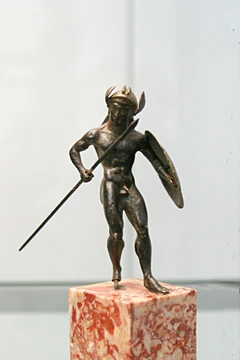
Battle of Megiddo (15th century BC)
First recorded battle with reliable detail, composite bow use, and body count.

The Battle of Megiddo, fought in the 15th century BC, was a military engagement between Egyptian forces under Pharaoh Thutmose III and a coalition of Canaanite vassal states led by the king of Kadesh. It is the first battle recorded in relatively reliable detail, with all accounts coming from Egyptian sources, primarily the hieroglyphic writings on the Hall of Annals in the Temple of Amun-Re at Karnak, Thebes (now Luxor), by the military scribe Tjaneni. The battle is notable for being the first recorded use of the composite bow and the first body count.
- Conflict
- Battle of Megiddo
- Location
- Megiddo, in the Jezreel Valley
- Belligerents
- Egypt under Thutmose III vs. Canaanite coalition led by the king of Kadesh
- Commanders
- Thutmose III (Egypt); King of Kadesh (Canaanite coalition)
- Outcome
- Egyptian victory; lengthy siege of Megiddo; reestablishment of Egyptian dominance in the Levant
Lore & Background
The battle occurred during Thutmose III's first campaign in the Levant, after he ended his regency under Hatshepsut. Despite advice from his generals to take safer routes, Thutmose chose the direct but risky Aruna route (Wadi Ara), leading his men personally through a narrow ravine. The enemy had left this route lightly guarded, allowing the Egyptians to enter the Jezreel Valley unopposed.
Reader's Guide
The Battle of Megiddo is significant as the first battle recorded in relatively reliable detail, providing historians with a rare glimpse into ancient warfare. It marks the first recorded use of the composite bow and the first body count, both documented in Egyptian hieroglyphics. The victory reestablished Egyptian dominance in the Levant, beginning a reign in which the Egyptian Empire reached its greatest expanse. The battle's legacy is preserved in the Annals of Thutmose III at Karnak, which detail 14 campaigns and show Egypt's rise to empire through diplomacy and tribute from regions like Babylon and the Hittite Empire. The battle also influenced later Egyptian policy, as defeated kings were required to send sons to the Egyptian court for education, fostering loyalty.
Did You Know?
- The Battle of Megiddo is the first battle recorded in what is accepted as relatively reliable detail.
- It is the first recorded use of the composite bow and the first body count.
- All details of the battle come from Egyptian sources, primarily the writings of the military scribe Tjaneni on the Hall of Annals at Karnak.
A Landmark in the Record of Warfare
The Battle of Megiddo stands as a watershed moment in how humanity documents armed conflict. Fought in the 15th century BC between Pharaoh Thutmose III's Egyptian forces and a broad Canaanite coalition, it holds the distinction of being the earliest engagement preserved in what scholars regard as relatively trustworthy detail. It is also credited as the first recorded deployment of the composite bow on a battlefield and the first instance of a formal body count following combat. Every surviving account of the fighting originates from Egyptian sources, most notably the hieroglyphic inscriptions carved into the Hall of Annals within the Temple of Amun-Re at Karnak in Thebes, now modern Luxor. These records were compiled by the military scribe Tjaneni, who had kept a daily journal on parchment during the campaign itself. The battle's outcome—routing the Canaanite army and forcing it into the walls of Megiddo—allowed Thutmose III to reassert Egyptian dominance across the Levant, setting the stage for a reign during which the Egyptian Empire would achieve its greatest territorial expanse.
The Gamble Through the Aruna Ravine
The most dramatic tactical choice of the campaign came when Thutmose III faced three possible approaches from Yehem to the fortress of Megiddo. The northern path via Zefti and Yokneam and the southern route through Taanach were both longer but wider and safer. The central route, threading through the narrow ravine at Aruna (modern Wadi Ara), offered a direct line to the Jezreel Valley but forced troops to march single-file through a confined corridor where an ambush could slaughter them piecemeal. His senior commanders urged him to choose one of the safer alternatives. Thutmose reasoned, however, that if his generals recommended the easy roads, the enemy would naturally expect him to take them. Acting on scout intelligence, he committed to the dangerous ravine. He personally led the advance, sending light infantry and mounted bowmen called haibrw ahead to sweep away any rebel pickets while the main chariot force followed behind. The King of Kadesh had stationed large infantry detachments on the two more probable approaches and left the Aruna path virtually unguarded. The Egyptian vanguard scattered the thin rebel screen, and the army poured into the valley unopposed, with the rebel main body still far to the northwest and southeast.
The Coalition and the Stakes of the Via Maris
The rebel alliance that Thutmose III confronted was not a minor uprising but a carefully assembled coalition of Canaanite vassal states, driven and led by the King of Kadesh, whose powerful fortress offered him and his allies a secure base. The King of Megiddo, commanding an equally formidable stronghold, joined the confederation. The Canaanites are believed to have maintained alliances with the Mitanni and the Amurru peoples from the region between the headwaters of the Orontes and the Jordan rivers. Strategically, Megiddo sat on the southwestern edge of the Jezreel Valley, just beyond the Mount Carmel ridge and the Mediterranean coast, giving it control over the Via Maris—the principal trade artery linking Egypt to Mesopotamia. As the Egyptians mustered between ten and twenty thousand chariots and infantry, the King of Kadesh gathered tribal chieftains from Syria, Aram, and Canaan, fielding an estimated ten to fifteen thousand men. He positioned his forces at the waters of Taanach, anticipating that the Egyptian army would follow the main route from the Mediterranean lowlands through Dothaim into the Valley of Kishon.
The Annals, the Gods, and a New Imperial Order
The primary surviving record of the battle comes from the Annals of Thutmose III, inscribed on the walls of Amun-Re's temple at Karnak. The source material was a daily journal kept on parchment by Thutmose's personal scribe Tjaneni during the campaign. Roughly in his 42nd regnal year, long after the Levantine wars had concluded, the pharaoh directed his artisans to carve the military exploits into the temple walls. The annals describe fourteen campaigns in lavish detail, cataloging booty, tribute from conquered regions, and offerings to Amun-Re. The sequence of depictions reflects the New Kingdom's theological understanding of warfare: praise and offerings to the gods in exchange for their divine assistance in battle. Beyond the military narrative, the annals reveal the long-term diplomatic consequences of Megiddo. Following Thutmose's victory and two further decades of successful campaigning, the inscriptions document Egypt's emergence as an imperial power, showing the exchange of gifts with Babylon, the Hittite Empire, and other major regions.
Frequently Asked Questions
Who fought in the Battle of Megiddo?
Egyptian forces under Pharaoh Thutmose III clashed with a coalition of Canaanite vassal states led by the king of Kadesh. The engagement took place in the Jezreel Valley during the 15th century BC.
What makes the Battle of Megiddo historically significant?
It is considered the first military engagement recorded with reliable detail and contains the earliest known body count from a battle. It also marks the first documented use of the composite bow in warfare.
What was the outcome of the Battle of Megiddo?
Thutmose III secured an Egyptian victory, which was followed by a lengthy siege of the city of Megiddo itself. The result reestablished Egyptian dominance over the Levant.
Where exactly did the Battle of Megiddo take place?
The fighting occurred at Megiddo, situated in the Jezreel Valley in the region known as the Levant.
How do we know the details of the Battle of Megiddo?
All surviving accounts come exclusively from Egyptian sources, primarily hieroglyphic inscriptions in the Hall of Annals at the Temple of Amun-Re in Karnak, Thebes (modern Luxor). These records were composed by a military scribe named Tjaneni.
More in Military History & Battles 1-20
Spotted an error? Know more?
This is a living reference — every entry is fact-audited, and reader corrections feed straight into our audit queue. Suggest an edit · See this site's audit record