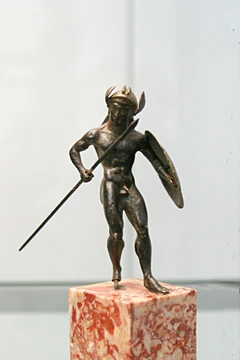
Battle of Ilipa
Scipio's reverse Cannae formation broke Carthaginian power in Iberia.

It may have taken place on a plain east of Alcalá del Río, Seville, Spain, near the village of Esquivel, the site of the Carthaginian camp. Though it may not seem to be as original as Hannibal's tactic at Cannae, Scipio's pre-battle maneuver and his reverse Cannae formation stands as the acme of his tactical ability, in which he permanently broke the Carthaginian hold in Iberia, thus denying any further land invasion into Italy and cutting off a rich base for the Barca dynasty both in silver and manpower.
- Conflict
- Second Punic War
- Location
- Plain east of Alcalá del Río, Seville, Spain, near Esquivel
- Roman commander
- Scipio Africanus
- Carthaginian commanders
- Hasdrubal Gisco and Mago Barca
Lore & Background
After several days of skirmishes, Scipio surprised the opposing army. In the battle, Scipio changed his formation, placing legionaries on the flanks and allied Iberians in the center. The Velites handled the elephants, driving them into a frenzy. The Carthaginian center could not assist its flanks without exposing itself, leading to demoralization and a rout. Hasdrubal and Mago escaped to Gades.
Reader's Guide
The Battle of Ilipa is significant as the engagement that permanently broke Carthaginian control in Iberia, cutting off a rich base of silver and manpower for the Barca dynasty and denying any further land invasion into Italy. Scipio's reverse Cannae formation, though less original than Hannibal's tactic at Cannae, is considered the acme of his tactical ability. The battle demonstrated Scipio's skill in pre-battle maneuver and his ability to adapt his formation to exploit enemy weaknesses. After the battle, Hasdrubal Gisco departed for Africa to visit King Syphax, while Mago Barca fled to the Balearics and later attempted an invasion of northern Italy. The battle's legacy lies in its decisive strategic impact, ending Carthaginian ambitions in Iberia and setting the stage for Scipio's later campaigns.
Did You Know?
- Scipio's reverse Cannae formation placed legionaries on the flanks and allied Iberians in the center, opposite the usual arrangement.
- The Carthaginian army included 32 elephants, which were driven into a frenzy by Roman Velites using javelins and trumpets.
- After the battle, Hasdrubal Gisco and Mago Barca escaped to Gades, and later Hasdrubal visited the Numidian king Syphax.
- The battle may have taken place on a plain east of Alcalá del Río, Seville, Spain, near the village of Esquivel.
Tactical Deception and the Reverse Cannae
Scipio's most celebrated achievement at Ilipa was not a single stroke of genius but a carefully staged deception spanning multiple days. For several days, both armies lined up in identical formations—legionaries in the center, Iberians on the flanks, Velites in front—while the Carthaginians mirrored this with their elite African infantry at the center, Iberian and cavalry units on the flanks, and light infantry with elephants at the front. This repetition lulled Hasdrubal and Mago into expecting the same engagement. Then, at dawn, Scipio sent Velites and cavalry to raid the enemy camp while the Carthaginians were still asleep and in disarray. When the two armies finally met, Scipio had quietly reversed his order: legionaries now occupied the flanks while allied Iberians held the center. The Iberians deliberately pulled back, refusing to engage the African center. The legionaries, fighting on the flanks against Iberian opponents, gained the upper hand. This reverse Cannae formation permanently broke Carthaginian dominance in Iberia.
Strategic Stakes and the Road to Ilipa
The path to Ilipa was paved with prior Roman successes and Carthaginian desperation. After the defeat at Baecula and Hasdrubal Barca's departure for Italy, Carthage dispatched fresh reinforcements under Hanno to join Mago Barca in Iberia, bolstered by Celtiberian recruits and Hasdrubal Gisco's force from Gades. The stakes were enormous: a Roman victory would deny any further land invasion of Italy and sever the Barca dynasty's access to Iberian silver and manpower.
The Dawn Assault and the Elephant Crisis
Scipio chose to strike at the moment of maximum Carthaginian vulnerability. Preparing his troops overnight, he dispatched Velites and cavalry to raid the enemy camp at dawn, catching many Carthaginian soldiers still asleep and the army emerging in complete disorder. Hasdrubal and Mago deployed their forces in the same formation they had used during the previous days of observation, a repetition that proved fatal. Scipio's Velites were positioned between the legionaries and cavalry along the line, specifically tasked with neutralizing the 32 elephants. Using javelins and the blaring of trumpets, the light-armed troops drove the beasts into a frenzy, and the panicked elephants trampled much of the Carthaginian cavalry. Meanwhile, the Roman legionaries, now on the flanks, overcame the Iberian soldiers in the Carthaginian army. The African center, unable to assist their comrades without exposing the formation's middle to Scipio's Iberian allies, grew demoralized. Seeing their elite troops lose hope, the rest of the Carthaginian army began fleeing, and when Scipio ordered his Iberians to pursue, what started as an orderly retreat collapsed into a full rout.
The Pursuit and the End of Carthaginian Iberia
The battle's decisive blow was followed by a relentless pursuit that sealed the Carthaginian defeat. Though temporarily safe in their camp, the remnants could not rest; facing the inevitable Roman assault the next morning, they were forced to strengthen their defenses. As night deepened, Iberian mercenaries increasingly deserted the Carthaginian side, and Hasdrubal attempted to slip away with his remaining men in darkness. Scipio immediately ordered a cavalry-led pursuit, and the full Roman army closed in. When the Romans caught up, the fighting that followed was brutal. Hasdrubal was reduced to just 6,000 men, who fled to a waterless mountain top and surrendered shortly after. Only Hasdrubal and Mago escaped, taking refuge in Gades. In the aftermath, Hasdrubal Gisco sailed for Africa to seek the support of the Numidian king Syphax, where he encountered Scipio, who was also courting Numidian favor. Mago Barca fled to the Balearic Islands, from where he would later sail to Liguria and attempt an invasion of northern Italy. The Carthaginian hold on Iberia was permanently broken.
Frequently Asked Questions
Where did the Battle of Ilipa take place?
The engagement occurred on a plain east of Alcalá del Río in Seville, Spain, in the area near the village of Esquivel where the Carthaginian camp was set up.
Who led the opposing forces at the Battle of Ilipa?
Scipio Africanus commanded the Roman army, while the Carthaginian side was jointly led by Hasdrubal Gisco and Mago Barca.
What made Scipio's tactics at Ilipa stand out?
Rather than simply copying Hannibal's double envelopment at Cannae, Scipio devised a 'reverse Cannae' arrangement that is regarded as the peak of his tactical skill. His careful pre-battle maneuvering combined with this inverted formation to secure the Roman victory.
Why is the Battle of Ilipa considered a turning point in the Second Punic War?
The Roman victory permanently shattered Carthaginian control over the Iberian Peninsula and eliminated the threat of a further land invasion into Italy. It also stripped the Barca family of a crucial base for both silver revenue and troop recruitment.
What was the ultimate result of the Battle of Ilipa?
Scipio's reverse Cannae formation delivered a decisive blow that broke Carthaginian military power in Iberia. This effectively ended Carthage's ability to project land forces into the Italian theater for the remainder of the war.
More in Military History & Battles 1-20
Spotted an error? Know more?
This is a living reference — every entry is fact-audited, and reader corrections feed straight into our audit queue. Suggest an edit · See this site's audit record