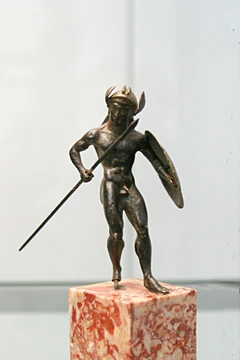
Battle of Ipsus
Decisive battle among Alexander's successors for control of his empire.

The combatants were Antigonus I Monophthalmus, the Greek Macedonian ruler of large parts of Asia, and his son Demetrius, against a coalition of three other successors: Cassander, ruler of Macedon; Lysimachus, ruler of Thrace; and Seleucus I Nicator, ruler of Babylonia and Persia. The battle is a key event in the wars that followed Alexander's death, determining the division of his empire.
- Location
- Near Ipsus, Phrygia
- Combatants
- Antigonus I Monophthalmus and Demetrius vs. Cassander, Lysimachus, and Seleucus I Nicator
- Outcome
- Not specified in the source
- Primary Sources
- Diodorus Siculus (fragmentary), Plutarch's Life of Demetrius
- Context
- Fourth War of the Diadochi
Lore & Background
The battle occurred after years of conflict among the Diadochi. Antigonus had gained control of Asian territories after the Second War, alarming other successors and leading to the Third War. Lysimachus avoided battle until Seleucus arrived, and after a winter campaign, Demetrius was summoned from Greece to reinforce Antigonus.
Reader's Guide
The Battle of Ipsus is significant as a pivotal moment in the struggle for Alexander the Great's empire, though the source provides no details of the battle itself. The principal ancient source, Diodorus Siculus, is fragmentary for the battle, while Plutarch's Life of Demetrius offers the only full description, written 400 years later. The battle's outcome reshaped the political landscape, but the source does not specify the result. The conflict leading to Ipsus illustrates the shifting alliances and military strategies of the Diadochi, with Antigonus's ambition uniting his rivals. The battle's legacy is tied to the fragmentation of Alexander's empire into Hellenistic kingdoms, though the source focuses on the prelude rather than the engagement.
Did You Know?
- The only full description of the battle is in Plutarch's Life of Demetrius, written some 400 years after the event.
- Diodorus Siculus's account of the battle only exists in fragments from book XXI onwards.
- Hieronymus of Cardia, a contemporary and possible eyewitness, is thought to be Diodorus's source for much of this period.
The Failed Diplomacy of Darius III
The first effort reportedly involved offering ten thousand talents as ransom for his captured family members, ceding territory west of the Halys River, and even proposing a relationship of co-equal monarchs. Alexander turned down every element of that proposal. A second overture, timed around the fall of Tyre, added the hand of Darius's daughter Stateira II in marriage to the territorial concession and a friendship treaty. Diodorus Siculus uniquely records that Alexander secretly showed his companions a doctored version of the letter that flattered his own ambitions. The third and most generous offer came after Alexander left Egypt: all land west of the Euphrates, shared rule of the empire, a daughter in marriage, and thirty thousand talents of silver. When his general Parmenion suggested accepting the terms, Alexander quipped that he would do so only if he were Parmenion. He insisted that Asia could have only one sovereign and demanded Darius either surrender or meet him on the battlefield.
The Military Campaign That Set the Stage
The confrontation at Gaugamela did not emerge in a vacuum; it was the culmination of a sweeping two-year campaign that steadily stripped Persia of its western provinces. The following year brought the grueling Siege of Tyre, which consumed the months from January through July and placed the entire Levant under Alexander's command, followed by the Siege of Gaza. In Egypt, the situation was markedly different: because so many Persian garrison troops had been diverted to reinforce the field army at Issus and subsequently perished there, the local satrap Mazaces chose to surrender without a fight when Alexander arrived. By the time the two armies prepared for their second and final clash, Alexander controlled a continuous arc of territory stretching from the Aegean coast through the Levant and into Egypt, while Darius had been forced to retreat to Babylon and rebuild his forces from the remnants of his previous army.
The Strategic March Through Mesopotamia
In the late spring or early summer of 331 BC, Alexander set out from Egypt, pushing northeast through Syria with his eyes on the Tigris. By July or August he had reached Thapsacus on the Euphrates, where Darius had stationed Mazaeus with three thousand cavalry to guard the crossing. Mazaeus, however, withdrew the moment the Macedonian army drew near, leaving the river unopposed. Rather than pressing directly southeast toward Babylon, Alexander chose a northern route that kept the Euphrates and the Armenian highlands on his left flank. This detour served two practical purposes: it opened up better foraging ground for his supply train and spared his troops the punishing heat of a more direct path. Captured Persian scouts confirmed that Darius had already established his camp beyond the Tigris. Alexander arrived at that river in late September and found it entirely undefended, yet the crossing itself proved extremely difficult. The march through this vast, open Mesopotamian landscape set the stage for the decisive engagement that would follow, with both commanders now committed to a final resolution of their rivalry.
The Final Blow to the Achaemenid Empire
Fought at Gaugamela, a small village situated on the banks of the Bumodus River just north of Arbela (the site of present-day Erbil in Iraqi Kurdistan), the engagement in 331 BC represented the second and last direct military confrontation between Alexander and Darius III. Its significance extended far beyond a single tactical victory: it is widely regarded as the decisive blow that shattered the Achaemenid Empire and opened the door to Alexander's complete conquest of Persia. What made the outcome remarkable was the disparity in numbers. The Macedonian force, fighting as part of the broader League of Corinth coalition, was heavily outnumbered by the Persian army. Yet Alexander's commanders exploited superior tactical coordination and made particularly effective use of light infantry to neutralize the Persian numerical advantage. The result was a decisive victory that ended Darius's reign and effectively dissolved the Achaemenid state, reshaping the political map of the ancient Near East and establishing Macedonian hegemony over territories that had been Persian for generations.
Frequently Asked Questions
Who fought in the Battle of Ipsus?
Antigonus I Monophthalmus and his son Demetrius clashed against a three-way coalition of rival successors: Cassander of Macedon, Lysimachus of Thrace, and Seleucus I Nicator of Babylonia and Persia.
Where and when did the Battle of Ipsus take place?
The engagement was fought near the town of Ipsus in Phrygia, in the region of modern-day Turkey, during the period of the Fourth War of the Diadochi following Alexander the Great's death.
What was the outcome of the Battle of Ipsus?
The battle proved decisive for the coalition side, effectively ending Antigonus's attempt to reunify Alexander's former territories under one ruler and cementing the empire's division among the surviving Diadochi.
Why is the Battle of Ipsus considered important in military history?
It stands as the pivotal engagement of the Fourth War of the Diadochi, determining how Alexander's vast empire would be permanently partitioned among his rival generals rather than restored to a single sovereign.
What ancient sources describe the Battle of Ipsus?
The principal surviving accounts come from Diodorus Siculus, whose narrative on the battle is only fragmentary, and from Plutarch's biographical sketch of Demetrius.
More in Military History & Battles 1-20
Spotted an error? Know more?
This is a living reference — every entry is fact-audited, and reader corrections feed straight into our audit queue. Suggest an edit · See this site's audit record