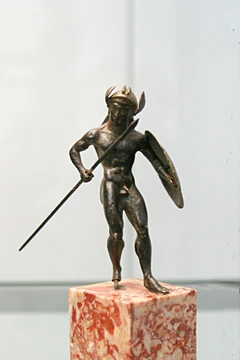
Battle of the Catalaunian Plains
A disputed battle that halted Attila's advance into Gaul.

The Battle of the Catalaunian Plains (also called the Battle of the Campus Mauriacus, Battle of Châlons, Battle of Troyes, or the Battle of Maurica) took place on 20 June 451 AD. It was fought between a coalition led by the Roman general Flavius Aetius and the Visigothic king Theodoric I against the Huns and their vassals commanded by their king, Attila. The battle proved to be one of the last major military operations of the Western Roman Empire, although Germanic foederati composed the majority of the coalition army. The exact strategic significance is disputed among historians.
- date
- 20 June 451 AD
- location
- Catalaunian Plains (Gaul)
- combatants
- Roman-Visigothic coalition vs. Huns and vassals
- commanders
- Flavius Aetius and Theodoric I vs. Attila
- outcome
- Indecisive; Huns halted but Gaul pillaged
- significance
- One of the last major Western Roman military operations
Lore & Background
By 450 AD, Roman authority in Gaul was diminishing, with Germanic tribes settled as foederati. Attila crossed the Rhine early in 451, sacking Divodurum (Metz) on 7 April, though some scholars question the reliability of this date. Other cities claimed attacked include Reims, Tongeren, and Troyes, but archaeological evidence shows no destruction layer for many. Attila's main column likely followed Roman roads from Argentoratum to Aurelianum, while a small detachment plundered northern Frankish territory. The siege of Aurelianum began before June; the Alan king Sangiban was said by Jordanes to have promised to open the gates, but modern scholars believe the Alans were loyal defenders. After four days of heavy rain, Attila's final assault on 14 June was broken off by the approach of the Roman coalition.
Reader's Guide
The Battle of the Catalaunian Plains is significant as one of the last major military operations of the Western Roman Empire, though its exact strategic importance is disputed. Historians generally agree that the siege of Aurelianum was the decisive moment, stopping the Huns' attempt to advance further into Roman territory or establish vassals in Gaul. However, the Huns looted and pillaged much of Gaul and crippled the military capacity of the Romans and Visigoths. The battle's legacy is complicated by unreliable sources like Jordanes, who may have projected later events onto Attila's time. The conflict was also influenced by the Frankish succession dispute and Honoria's plea for help, though interpretations vary. The battle remains a key event in the decline of Roman power in the West.
Did You Know?
- The battle is also called the Battle of the Campus Mauriacus, Battle of Châlons, Battle of Troyes, or the Battle of Maurica.
- The siege of Aurelianum (Orléans) is considered by modern scholars to be the decisive moment of the campaign.
- Attila's army reached Aurelianum before June 451, and his final assault on 14 June was broken off by the approach of the Roman coalition.
- The Alan king Sangiban was accused by Jordanes of planning to defect, but modern scholars believe the Alans were loyal defenders.
More in Military History & Battles 1-20
Spotted an error? Know more?
This is a living reference — every entry is fact-audited, and reader corrections feed straight into our audit queue. Suggest an edit · See this site's audit record