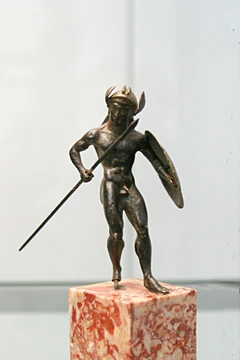
Battle of the Hydaspes
Alexander's costly victory on the Hydaspes River against Porus.

The Battle of the Hydaspes, also known as the Battle of Jhelum or First Battle of Jhelum, was fought in May of 326 BC between the Macedonian Empire under Alexander the Great and the Pauravas under Porus. It took place on the banks of the Hydaspes River in what is now the Punjab province of Pakistan, as part of Alexander's Indian campaign. The Macedonian army secured a decisive victory, captured Porus, and subsequently absorbed large areas of Punjab into the Macedonian Empire; Alexander spared Porus and made him a satrap, effectively reinstating him as the region's ruler.
- Date
- May 326 BC
- Location
- Banks of the Hydaspes River (modern-day Punjab, Pakistan)
- Combatants
- Macedonian Empire (Alexander the Great) vs. Pauravas (Porus)
- Result
- Macedonian victory; Porus captured and later reinstated as satrap
- Significance
- Exposed Greek political and cultural influences to the Indian subcontinent; marked the farthest advance of Alexander in India
Lore & Background
A smaller force under Alexander took the fortress of Aornos, a place of mythological significance where Herakles was said to have failed. In early spring of 326 BC, Alexander allied with Taxiles (Ambhi) of Taxila against Porus the Elder, who had refused to surrender. Porus chose the spot to check Alexander's advance and became Alexander's most successful recorded opponent, according to historian Peter Green, outclassing Memnon of Rhodes and Spitamenes. Alexander fixed his camp on the north banks of the Hydaspes, while Porus drew up on the south bank. The river was deep and fast, making a direct crossing nearly impossible. Alexander moved his mounted troops along the bank each night, with Porus shadowing him. Eventually, Alexander found a suitable crossing about 27 km upstream, using an uninhabited, wood-covered island. He crossed with a contingent of 6,000 on foot and 5,000 on horseback (according to Arrian), leaving Craterus behind with most of the army. Through feints and deception, including a look-alike in a mock royal tent, Alexander crossed the river in secrecy, using skin floats and cut vessels. Porus' son, also named Porus, was sent with a small force but was routed and killed. The two armies arrayed for battle. The Indians had cavalry on both flanks, chariots in front, and infantry with war elephants stationed every fifty feet. Porus rode his tallest war elephant without a howdah, clad in chain mail. Alexander attacked with cavalry on the flanks, holding his phalanx back until Indian cavalry was neutralized. The Macedonian phalanx was outnumbered 1:5 but had an advantage in close combat due to longer sarissas and the Indians' lack of armor. Alexander sent Dahae horse archers to harass the Indian right-wing cavalry and his Companion cavalry against the left wing.
Reader's Guide
The Battle of the Hydaspes is significant as one of Alexander's most costly engagements and a masterpiece of tactical deception. Alexander's decision to cross the monsoon-swollen river under close surveillance and catch Porus' army in the flank is considered a masterstroke. The battle resulted in the exposure of Greek political and cultural influences to the Indian subcontinent, which continued to affect Greeks and Indians for centuries. After the battle, Alexander continued eastward but stopped at the Hyphasis (Beas) in 326 BC when his weary troops refused to advance further, having campaigned for nearly eight years. Arms and armor were wearing out, and there was concern about disaster in India. The Hyphasis marked the farthest advance of Alexander in India, and he left King Porus in charge of this easternmost territory. The battle also demonstrated the effectiveness of Macedonian combined arms against war elephants and the resilience of Porus, who despite defeat became Alexander's most respected opponent.
Did You Know?
- Alexander's crossing of the Hydaspes used 'skin floats filled with hay' and 'smaller vessels cut in half, the thirty oared galleys into three'.
- Porus eschewed the usual tradition of Indian kings fighting from a chariot and instead mounted his tallest war elephant, clad in chain mail armor.
- The battle resulted in the exposure of Greek political and cultural influences to the Indian subcontinent, affecting Greeks and Indians for centuries.
- Alexander stopped at the Hyphasis (Beas) in 326 BC after his weary troops refused to advance further, having campaigned for nearly eight years.
More in Military History & Battles 1-20
Spotted an error? Know more?
This is a living reference — every entry is fact-audited, and reader corrections feed straight into our audit queue. Suggest an edit · See this site's audit record