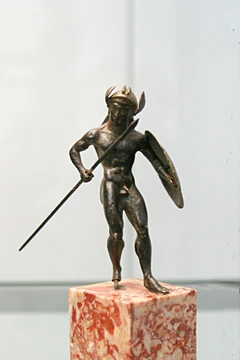
Battle of Thermopylae

Lasting over the course of three days, it was one of the most prominent battles of both the second Persian invasion of Greece and the wider Greco-Persian Wars.
- Location
- Thermopylae
- Combatants
- Achaemenid Persian Empire vs. alliance of Greek city-states
- Greek Commander
- Leonidas I of Sparta
- Persian Commander
- Xerxes I
- Greek Force Size
- Approximately 7,000 men, including an estimated 300 Spartans
Lore & Background
The Athenian politician Themistocles proposed blocking the Persian army at Thermopylae while the navy blocked the Straits of Artemisium. The Greek force of about 7,000 men, led by Leonidas, held the pass for seven days, including three days of direct battle. After two days, a local resident named Ephialtes revealed a path behind Greek lines. Most Thebans reportedly surrendered; the rest fought to the death.
Reader's Guide
The Battle of Thermopylae is one of the most famous last stands in history. Both ancient and modern writers have used it as a flagship example of the power of an army defending its native soil. The performance of the Greek defenders is also used as an example of the advantages of training, equipment, and use of terrain as force multipliers. The battle's outcome allowed the Persians to overrun Boeotia and capture Athens, but the Greek fleet later won at Salamis, and the following year a Greek army decisively defeated the Persians at Plataea, ending the second invasion. The primary source is Herodotus, with additional accounts from Diodorus Siculus, Ctesias, and others.
Did You Know?
- The battle lasted three days, but the Greeks held the pass for seven days total.
- A local resident named Ephialtes revealed a path that allowed the Persians to outflank the Greeks.
- The battle occurred simultaneously with the naval Battle of Artemisium.
Frequently Asked Questions
What is the Battle of Thermopylae?
It was a three-day engagement fought at the narrow mountain pass of Thermopylae during the second Persian invasion of Greece. A coalition of Greek city-states, led by Sparta, held the chokepoint against the vastly larger Achaemenid army under Xerxes I. The fight is one of the most iconic confrontations in the broader Greco-Persian Wars.
Who commanded the Greek side at Thermopylae?
King Leonidas I of Sparta led the Greek alliance, bringing with him an estimated 300 Spartan hoplites as part of a combined force of roughly 7,000 men drawn from multiple Greek city-states. On the Persian side, the campaign was directed by Emperor Xerxes I himself.
How did the Battle of Thermopylae end?
After two days of repelling waves of Persian infantry, the Greeks were outflanked when a local guide revealed a mountain trail that let Xerxes' forces bypass the narrow pass. Leonidas and the rearguard were ultimately overwhelmed, though the stand had already bought critical time for the wider Greek defense.
Why is the Battle of Thermopylae so important?
It became a lasting symbol of standing firm against overwhelming odds, shaping how Western culture remembers courage and sacrifice. Strategically, the three-day delay helped the Greek naval and land forces reorganize ahead of the decisive engagement at Salamis.
How large was the Greek force compared to the Persians?
The Greek coalition numbered around 7,000 troops, including the famous contingent of roughly 300 Spartans. They faced the Achaemenid Persian army, which was many times their size, making the narrow terrain at Thermopylae the Greeks' only realistic chance to contest the advance.
More in Military History & Battles 1-20
Spotted an error? Know more?
This is a living reference — every entry is fact-audited, and reader corrections feed straight into our audit queue. Suggest an edit · See this site's audit record