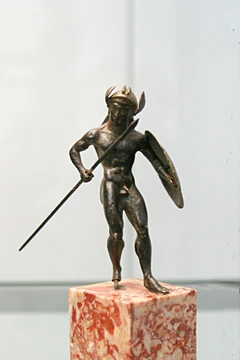
Battle of Zama
Decisive Roman victory ending the Second Punic War.

The battle was part of the Second Punic War and resulted in such a severe defeat for the Carthaginians that they capitulated, while Hannibal was forced into exile.
- location
- what is now Tunisia
- combatants
- Roman army vs. Carthaginian army
- roman_commander
- Scipio Africanus
- carthaginian_commander
- Hannibal
Lore & Background
The battle opened with a charge by the Carthaginian elephants, which were repulsed, some retreating through the Carthaginian cavalry on each wing and disorganising them. The Roman cavalry units on each wing took advantage to charge their counterparts, rout them and pursue them off the battlefield. The two armies' close-order infantry were each deployed in three lines. The first two lines engaged each other and after a hard-fought combat the Carthaginians were routed. The second Carthaginian line then fanatically assaulted the Roman first line, inflicting heavy losses and pushing it back. After the Romans committed their second line the Carthaginians were forced to withdraw. There was a pause, during which the Romans formed a single extended line, to match that of the Carthaginians. These two lines charged each other, according to the near-contemporary historian Polybius 'with the greatest fire and fury'. The fight continued for some time, neither side gaining the advantage. The Roman cavalry then returned to the battlefield and charged the Carthaginian line in the rear, routing and destroying it.
Reader's Guide
The Battle of Zama was the decisive engagement of the Second Punic War. Carthage was left with no army with which to continue the war. The peace treaty dictated by Rome stripped Carthage of its non-African territories and some of its African ones. Thereafter, it was clear that Carthage was politically subordinate to Rome. The main source for the battle is the historian Polybius, whose account is considered broadly objective but has been debated. Modern historians largely accept Polybius's account at face value, though some details are missing or fragmentary. The battle demonstrated the effectiveness of Roman cavalry tactics and the vulnerability of war elephants when properly countered. It ended Hannibal's long campaign and established Rome as the dominant power in the western Mediterranean.
Did You Know?
- The Carthaginians had 80 war elephants at the battle.
- The Roman cavalry routed the Carthaginian cavalry and pursued them off the battlefield, later returning to charge the Carthaginian line in the rear.
- The peace treaty stripped Carthage of its non-African territories and some of its African ones.
More in Military History & Battles 1-20
Spotted an error? Know more?
This is a living reference — every entry is fact-audited, and reader corrections feed straight into our audit queue. Suggest an edit · See this site's audit record